Researchers Propose Three-Stage Training Paradigm for Future-Aware LLM Agents
According to a preprint published on arXiv, researchers have proposed a new training approach to enable large language model (LLM) agents to simulate future outcomes before making decisions in long-horizon tasks.
The paper, titled “Internalizing the Future: A Unified Agentic Training Paradigm for World Model Planning,” identifies what the authors call a “format-capability gap”—where fine-tuning agents on look-ahead traces leads to “superficial mimicry of foresight without genuine predictive grounding,” according to the abstract.
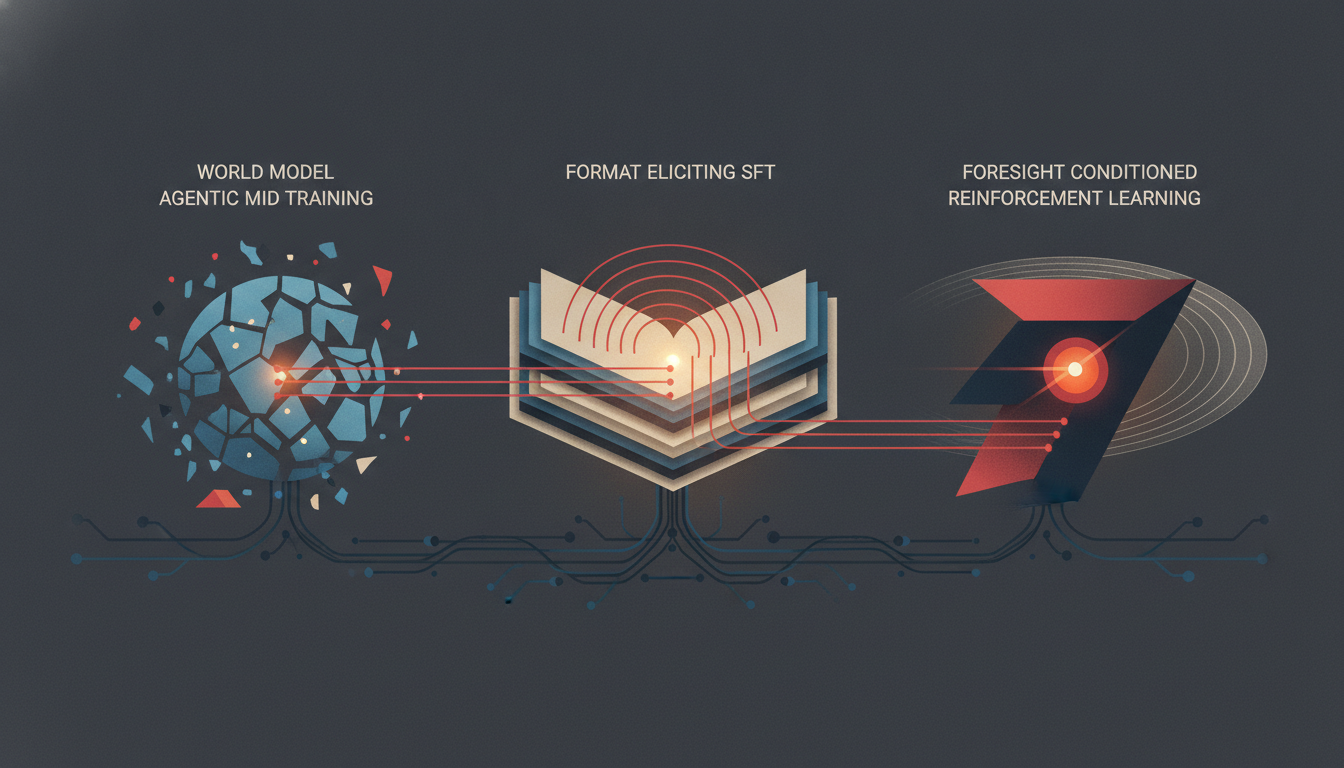
To address this, the researchers introduce a three-stage training paradigm: World Model Agentic Mid-Training (WM-AMT) to inject predictive capabilities; Format-Eliciting SFT (FE-SFT) to structure these capabilities; and Foresight-Conditioned Reinforcement Learning (FC-RL) to refine calibration and utility of generated simulations. The approach trains a single autoregressive model to generate both a prospective state rollout and a plan-conditioned success estimate, described as “a textual analogue of the Q-value.”
According to the paper, when evaluated on search and mathematical reasoning tasks, the approach “consistently outperforms other training baselines.” The research demonstrates that “effective internal world modeling in LLM agents requires a capability-first training pipeline to achieve grounded and calibrated foresight,” according to the abstract.
The preprint was submitted to arXiv on June 25, 2026, by Xuan Zhang and colleagues.