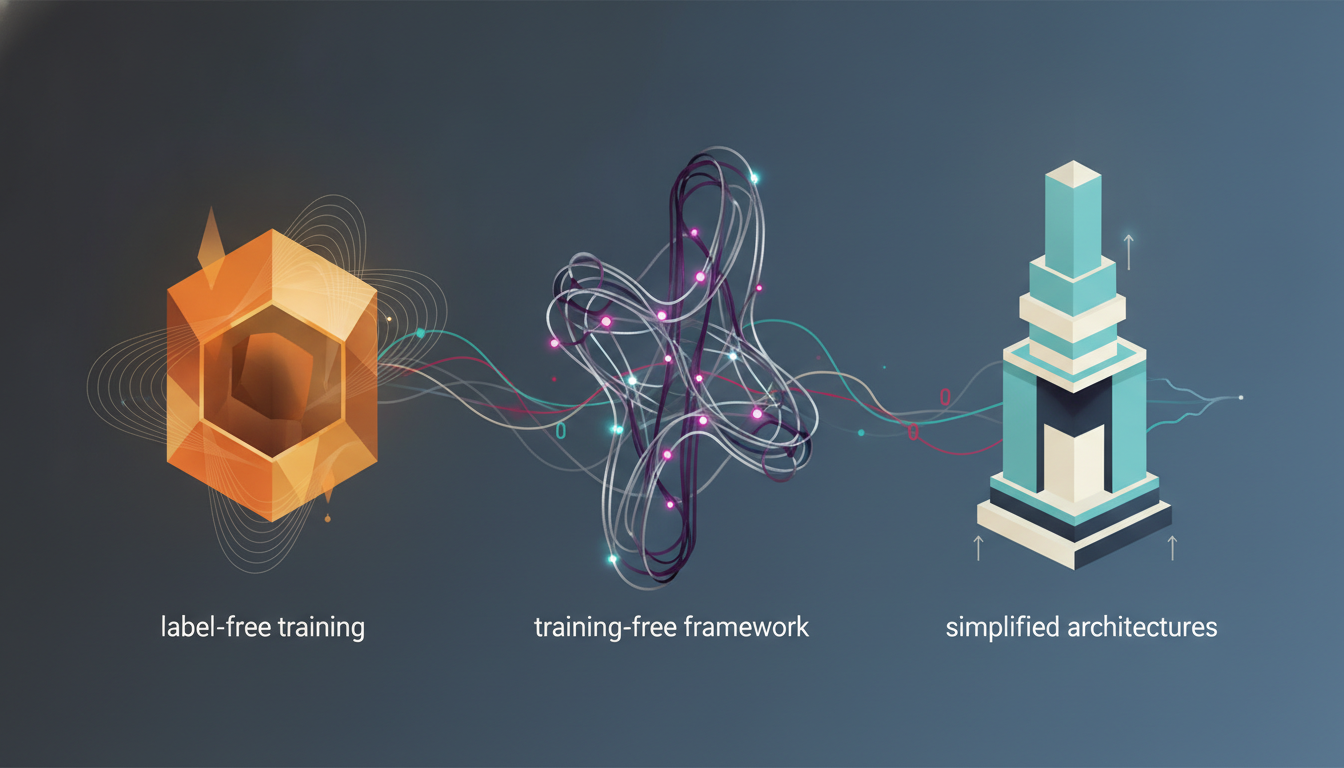
According to arxiv.org, researchers have published three separate papers addressing different challenges in AI model development.
A team introduced CANON (Consensus-ANchored self-distillatiON), a label-free training method that converts consensus signals into token-level supervision for large language models. According to the paper published July 17, 2026, the method samples multiple solutions for each prompt, extracts the majority answer, and uses a frozen model snapshot conditioned on a consensus-reaching solution to supervise training. Experiments on mathematical and scientific reasoning benchmarks showed CANON improved pass@1 accuracy by up to 12 points, outperforming label-free reinforcement learning by 6 points while using one-seventh of the compute, according to arxiv.org.
Separately, researchers presented AgentHOI, a training-free framework for human-object interaction detection that leverages multimodal reasoning capabilities of foundation models. According to arxiv.org, the system uses “Context-aware Multi-round Reasoning” and “Multifaceted Interaction Localization” to address incomplete interaction discovery and ambiguous localization. The paper states AgentHOI achieved superior performance over state-of-the-art supervised and weakly supervised methods despite requiring no training data.
A third team introduced ELF, a family of three encoder-free ECG-Language Models that simplify architecture while remaining competitive with prior state-of-the-art models across two datasets, according to arxiv.org. The work was accepted to MLHC 2026.