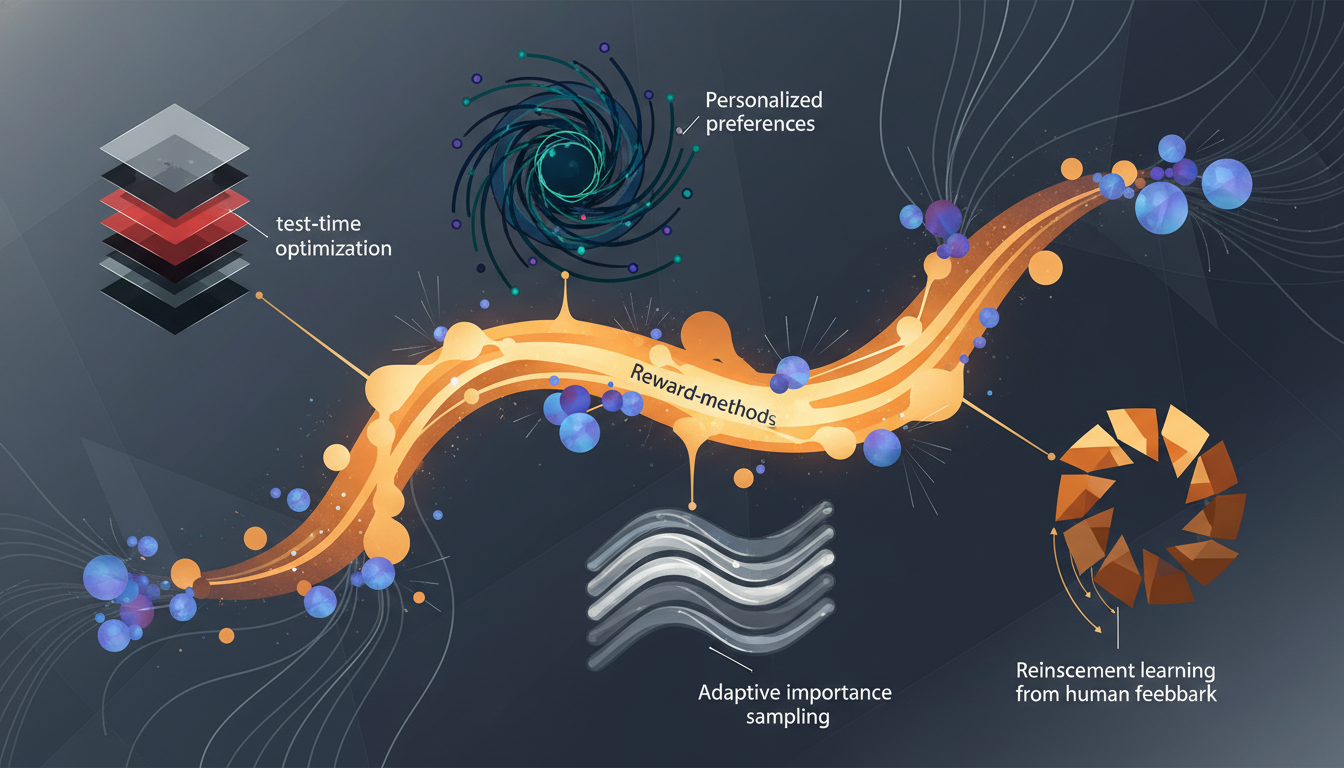
Researchers have published multiple approaches to improving language model alignment through reward-based methods, according to recent papers on arxiv.org.
A paper published June 4, 2026, introduces adaptive importance sampling on pre-logits (AISP), a test-time alignment method that “applies the Gaussian perturbation into pre-logits, which are outputs of the penultimate layer, so as to maximize expected rewards,” according to arxiv.org. The researchers report that AISP “outperforms best-of-n sampling in terms of rewards over the number of used samples and achieves higher rewards than other reward-based test-time alignment methods.”
Another paper from June 2, 2026, proposes using sparse Mixture-of-Experts (MoE) reward models for preference modeling in reinforcement learning from human feedback (RLHF). According to arxiv.org, the approach “encourages sparse routing and expert diversity during training on binary preference data” and “improves test-time personalization.”
A third paper explores aligning models in “fuzzy” domains using online natural language feedback. The researchers tested their methods on Qwen3-8B and Haiku 4.5, reporting that “ICL methods recover up to 35% of performance with 50x fewer expert samples, while fine-tuning methods recover 80% with up to 20x fewer samples,” according to arxiv.org.
A fourth paper addresses reasoning segmentation, proposing CR-Seg, which uses attention maps and chain-of-thought reasoning for visual-textual tasks, according to arxiv.org.