According to arxiv.org, researchers have developed multiple knowledge-centric frameworks to enhance AI agents’ reasoning and decision-making capabilities.
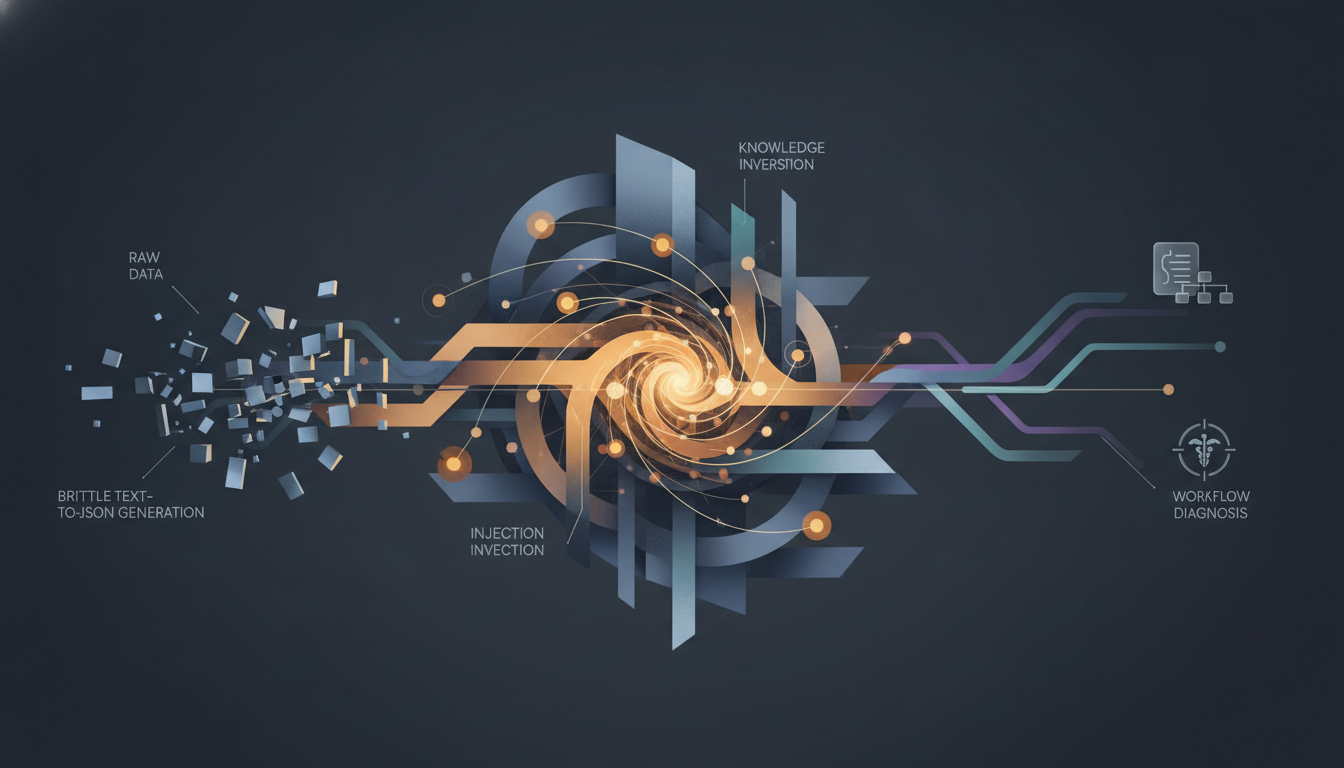
A team presented a knowledge-centric framework for workflow generation in visual creation systems like ComfyUI, accepted to ECCV 2026. According to the paper, existing large language model (LLM) approaches “often treat this as a direct text-to-JSON generation task, struggling with structural brittleness.” The framework performs “knowledge inversion” to distill hierarchical representations from real-world workflows, then conducts “knowledge injection through supervised fine-tuning.” Experiments demonstrated that the method produces “workflows with richer node diversity, more coherent structures, and higher execution success rates than existing systems,” according to arxiv.org.
Separately, researchers introduced GraphDx, a cost-aware framework for medical diagnosis that addresses what they describe as a “critical knowledge-reasoning gap” where LLMs “struggle to reason systematically under cost constraints, often resorting to excessive testing.” According to arxiv.org, the system uses Medical Diagnosis Knowledge Graphs (MDKGs) and three collaborative agents for perception, reasoning, and decision-making. Testing on MedQA and MIMIC-IV datasets showed GraphDx “improves diagnostic success rates from 50-68% to 79-93% while reducing test costs by 20-54%,” according to the paper.
Additionally, researchers released KDFlow, a knowledge distillation framework for compressing large language models that achieves “1.44× to 6.36× speedup compared to current KD frameworks,” according to arxiv.org.