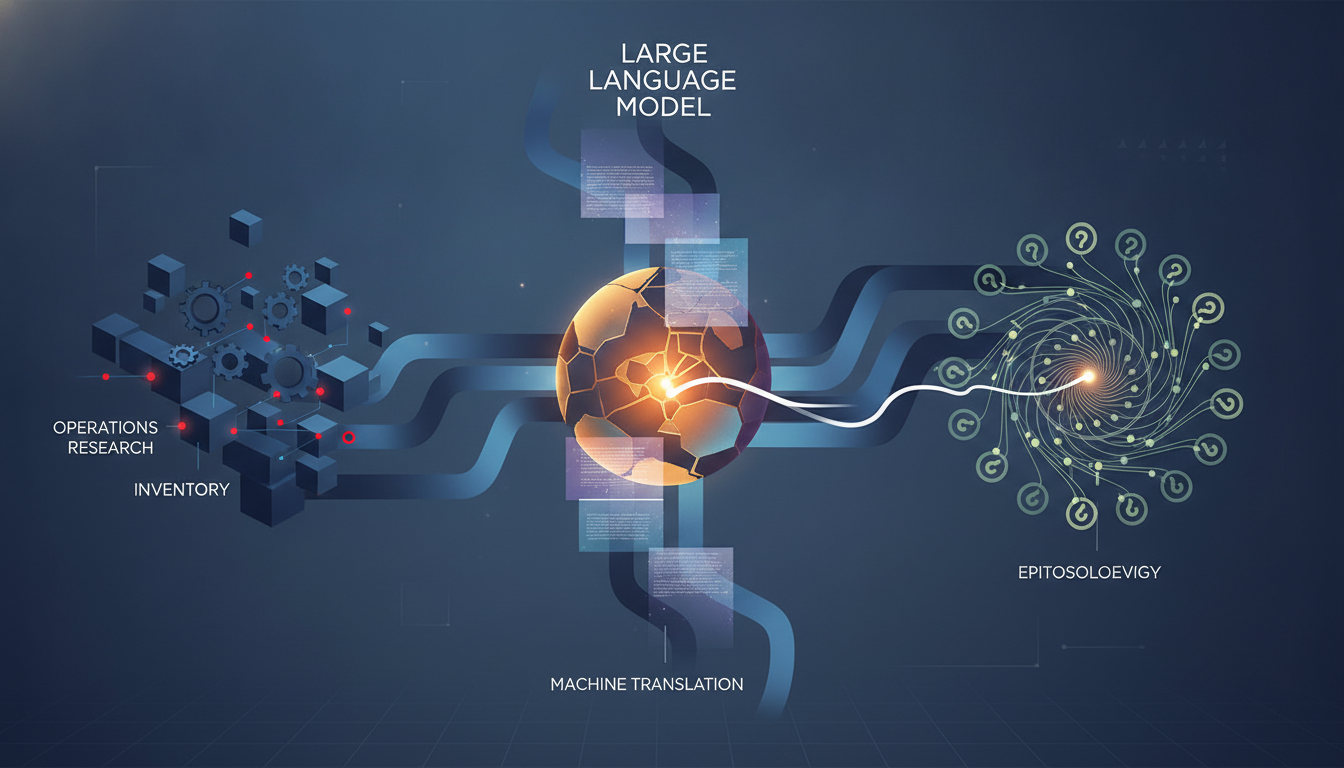
Four research papers published on arXiv on July 29, 2026, explore diverse applications and implications of large language models.
Operations Research Formulation Selection
According to arxiv.org (arXiv:2607.25956), researchers developed a solver-guided LLM framework for selecting operations research formulations in multi-warehouse inventory allocation. The study used instances from JD.com, one of China’s largest e-retailers, and employed a training approach combining supervised fine-tuning with group relative policy optimization (GRPO). The framework improved Hit Ratio@1 from 21.45% to 50.42% and achieved “an allocation accuracy gain of 12.57 percentage points over the incumbent baseline,” reducing the gap to the optimal oracle to 4.85 percentage points.
Reading Comprehension Analysis
A separate study (arXiv:2607.24797) examined how LLMs process reading and writing through a single autoregressive path, contrasting with the human brain’s separate systems. According to the research, “comprehension and production are positively coupled in all 12 non-degenerate models,” opposite to the brain’s double dissociation.
Literary Translation
Researchers introduced the TinyFabulist Translation Framework (arXiv:2509.07829) for English-to-Romanian literary translation, generating 15,000 Romanian references and fine-tuning a 12B-parameter model. The framework was published in Frontiers in Artificial Intelligence.
Epistemic Considerations
Finally, arxiv.org (arXiv:2607.25620) proposed the concept of “epistemic schizologia” to describe the separation between LLM-generated linguistic expressions and socially embedded knowledge practices, expanding on the concept of “Epistemia.”