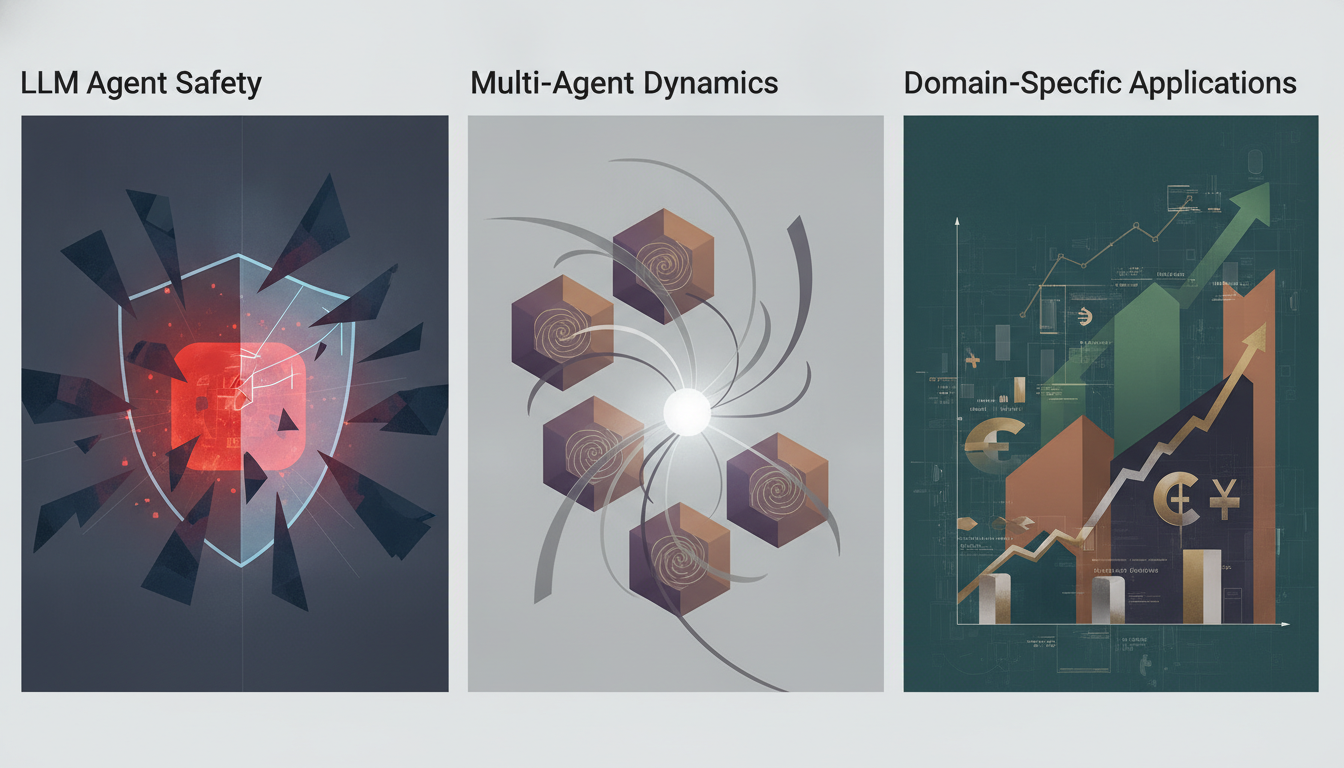
New Research Examines LLM Agent Safety, Multi-Agent Dynamics, and Domain-Specific Applications
Researchers have released NRT-Bench, a benchmark for evaluating large language model (LLM) agent robustness in safety-critical scenarios. According to arxiv.org, the benchmark uses a simulated nuclear power plant control room where adversaries attempt to manipulate LLM-backed operator teams through multi-turn attacks. The study found that “between 8.7% and 12.1% of attack sessions end with the plant losing a critical safety function” across four frontier models, with vulnerabilities being “nearly disjoint across models rather than nested.”
In a separate study on multi-agent deliberation, arxiv.org reports that researchers modeled LLM agents as carrying “hidden internal belief” anchors that influence their reasoning. The paper demonstrates that “an agent’s confidence in the correct answer can climb past where any agent started, escaping the space (convexhull) formed by the initial beliefs.”
Two domain-specific frameworks were also introduced. According to arxiv.org, the “AI Economist Agent” uses knowledge graphs and retrieval-augmented generation to produce economic reports “grounded in explicit model-based computations” for applications including U.S. inflation analysis and bank stress-test narratives.
Arxiv.org describes FundaPod, a “multi-persona agent platform” for fundamental investment research where AI agents with different investment personas “conduct research independently” and surface disagreements to human portfolio managers through a knowledge-graph memory system.