New Research Advances Fine-Tuning Methods for Large Language Models Across Multiple Domains
Researchers have published multiple studies advancing fine-tuning techniques for large language models across diverse applications, all appearing on arxiv.org on June 23, 2026.
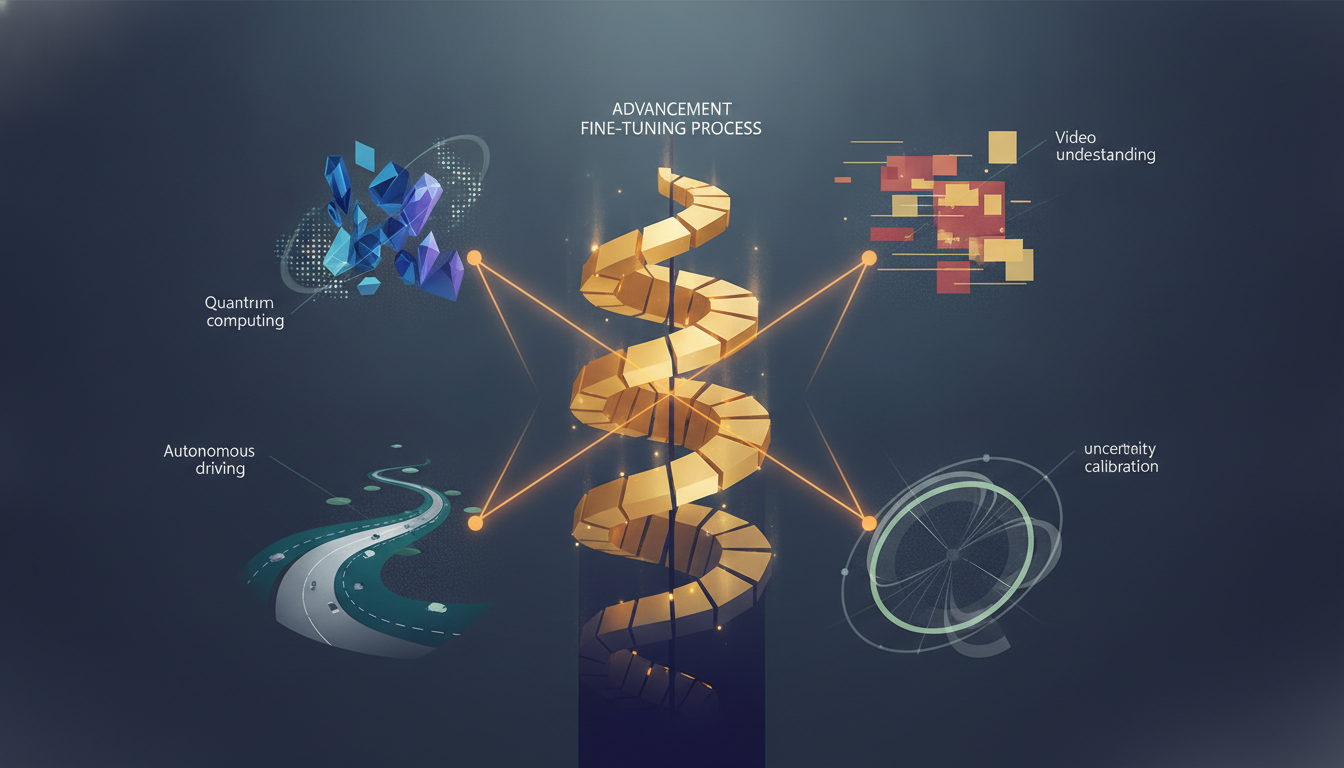
According to arxiv.org, a team introduced MAGNIFIED, a reinforcement learning fine-tuning approach for multimodal large language models in autonomous driving. The method addresses limitations of traditional next-token prediction by learning from token-level rewards mapped to vehicle trajectories. Testing on the Waymo Open Motion Dataset demonstrated “over a 10.5% reduction in overlap rate and a 38.9% reduction in off-road rate” compared to supervised fine-tuning baselines.
In quantum computing, arxiv.org reports that researchers developed fine-tuning pipelines to instill “genuine quantum reasoning” in LLMs through quantum circuit simulation tasks. The study compared supervised fine-tuning with a two-stage approach combining supervised fine-tuning and Group Relative Policy Optimisation, finding that both “significantly outperform the baselines.”
For video understanding, arxiv.org describes VideoLatent, which uses a “latent self-forcing training paradigm” requiring only standard video-question-answer triplets. The approach achieved superior performance across 14 benchmarks while reducing training and inference overhead by “~6×/~68×” compared to Video-R1.
Finally, arxiv.org reports research on uncertainty communication showing that supervised fine-tuning improves alignment between stated confidence and answer accuracy. However, “single-task training does not reliably transfer between” different confidence tasks, while “multitask fine-tuning produces broader gains.”