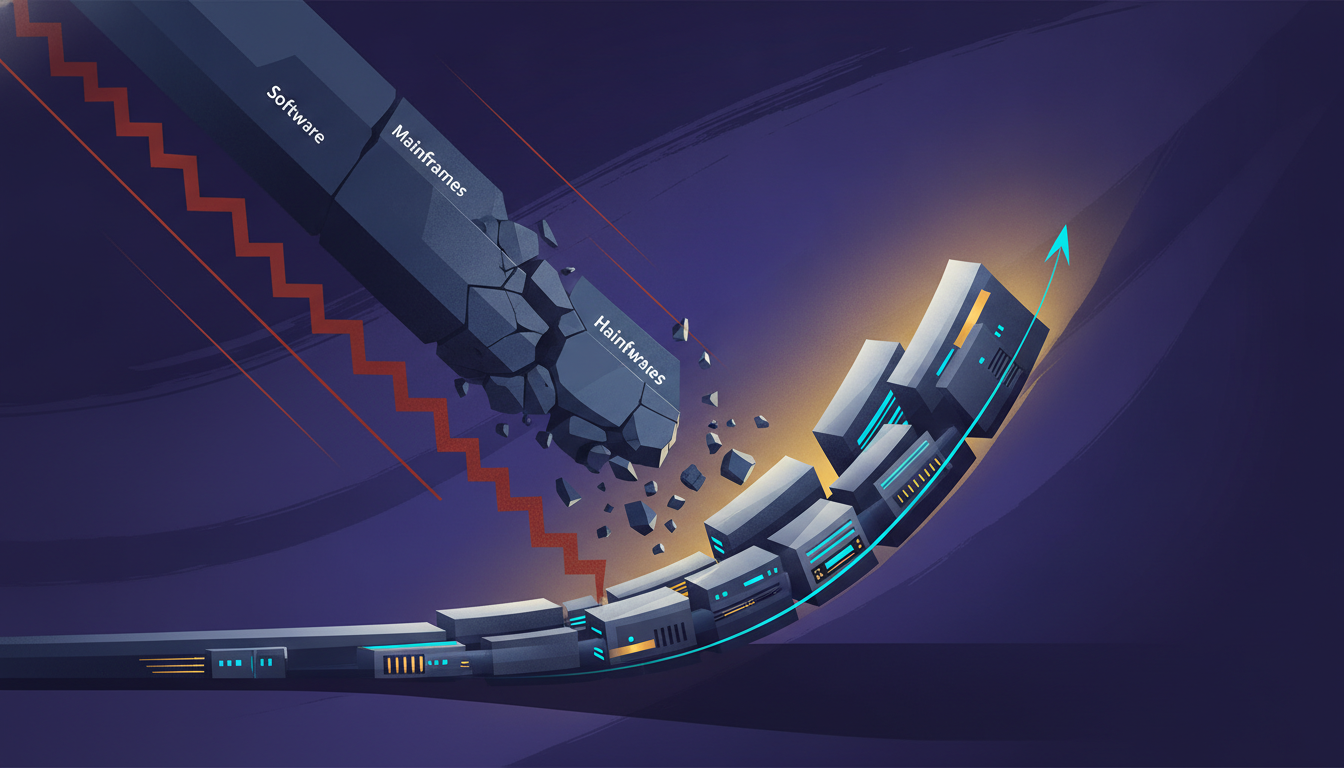
IBM’s stock experienced a significant decline on Tuesday, July 14, 2026, with shares plummeting between 20% and 26% following a preliminary second-quarter earnings warning. The tech giant attributed the unexpected shortfall to a widespread shift in client spending patterns, where businesses are prioritizing artificial intelligence (AI) infrastructure hardware, such as servers, storage, and memory, over software and mainframe purchases.
According to IBM CEO Arvind Krishna, clients redirected their capital expenditure in the final weeks of June to secure supply-constrained infrastructure ahead of anticipated price increases. This reprioritization led to a “shortfall” in the performance of IBM’s software and infrastructure division, particularly impacting its z17 mainframes, which are designed to process AI workloads, and associated software.
IBM’s preliminary Q2 2026 results project revenue of $17.2 billion, falling short of analysts’ expectations of $17.86 billion. Adjusted earnings per share are anticipated to be $2.93, below the $3.02 forecast by analysts. While software revenue saw a 5% increase, infrastructure revenue notably decreased by 7%.
In a letter to investors, Krishna acknowledged that IBM “faltered” in adapting quickly enough to these evolving market conditions, resulting in numerous large deals failing to close on expected timelines. He stated, “We did not anticipate the magnitude of the capex reprioritization.”
The sharp drop in IBM’s share price had a ripple effect across the technology sector, dragging down other software providers like Salesforce and Microsoft, and causing the iShares Expanded Tech-Software Sector ETF to decline. Analysts noted that this indicates a broader concern among investors about how increased AI infrastructure spending is impacting software budgets across the industry.
Despite the immediate financial challenges, the shift is seen as a reallocation of AI budgets rather than a contraction of overall AI spending. IBM also continues to invest strategically in AI, including updates to its Bob AI platform and significant commitments to quantum computing.