Four new research papers published on arXiv on June 16, 2026, advance different aspects of AI model development and training.
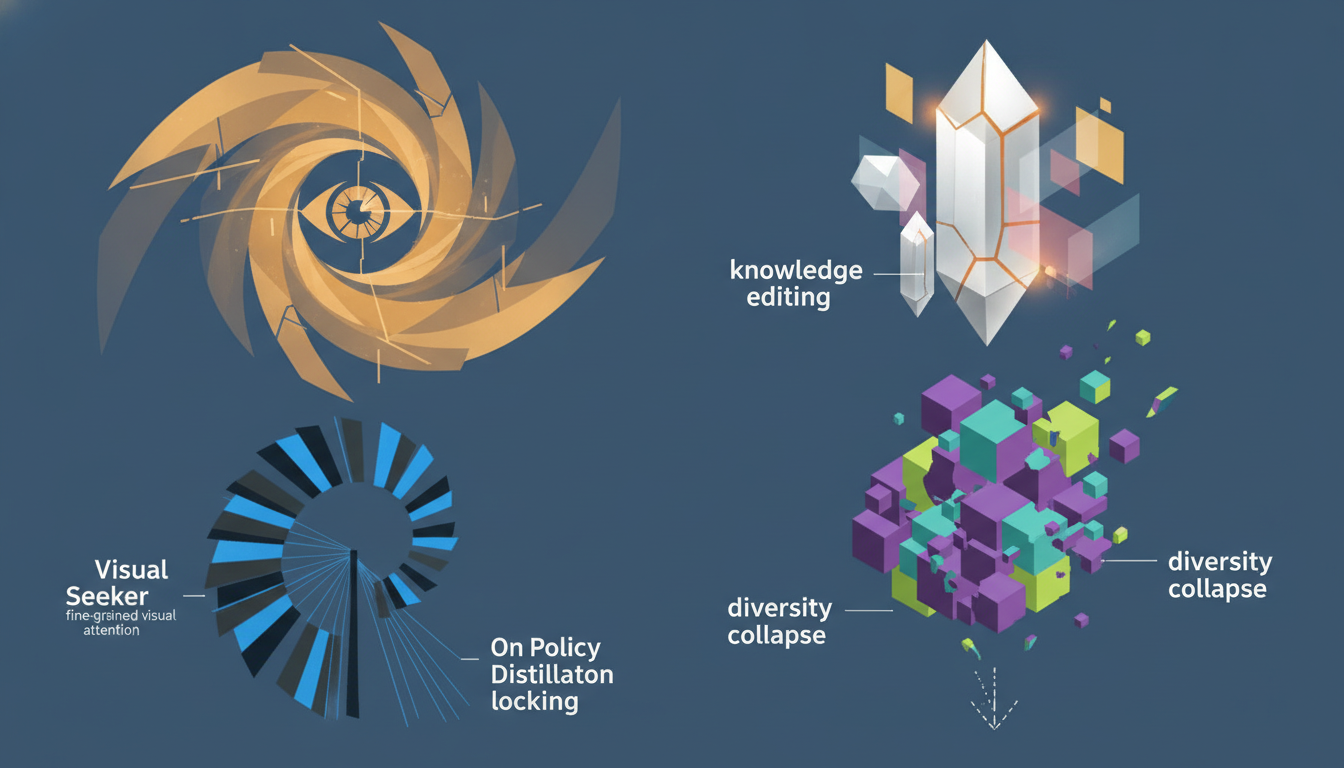
According to arxiv.org, researchers introduced Visual-Seeker, a visual-native multimodal deep search agent designed to address factual grounding challenges in multimodal large language models (MLLMs). The system actively attends to fine-grained visual details and dynamically harvests visual evidence throughout the search process, moving beyond treating vision as static input.
In a separate paper on arxiv.org, researchers characterized the geometry of on-policy distillation (OPD) in parameter space, comparing it with supervised fine-tuning and reinforcement learning with verifiable rewards (RLVR). The study found that OPD “exhibits subspace locking: its cumulative updates rapidly enter a narrow low-dimensional channel,” and that OPD “induces its own update geometry in parameter space” rather than being merely an intermediate approach.
Another arxiv.org paper examined diversity collapse in RLVR, where Pass@1 improves while high-k Pass@k degrades. The researchers proposed Bayesian Boundary Gating (BBG), which “redirects optimization away from overtraining by estimating each problem’s marginal contribution to the reasoning boundary.” According to the paper, BBG improved average Pass@k across multiple reasoning benchmarks.
Finally, researchers on arxiv.org proposed treating knowledge updates as a reasoning problem rather than memorization, training models with coherent background stories and self-generated multi-hop questions requiring multi-step reasoning with new information.