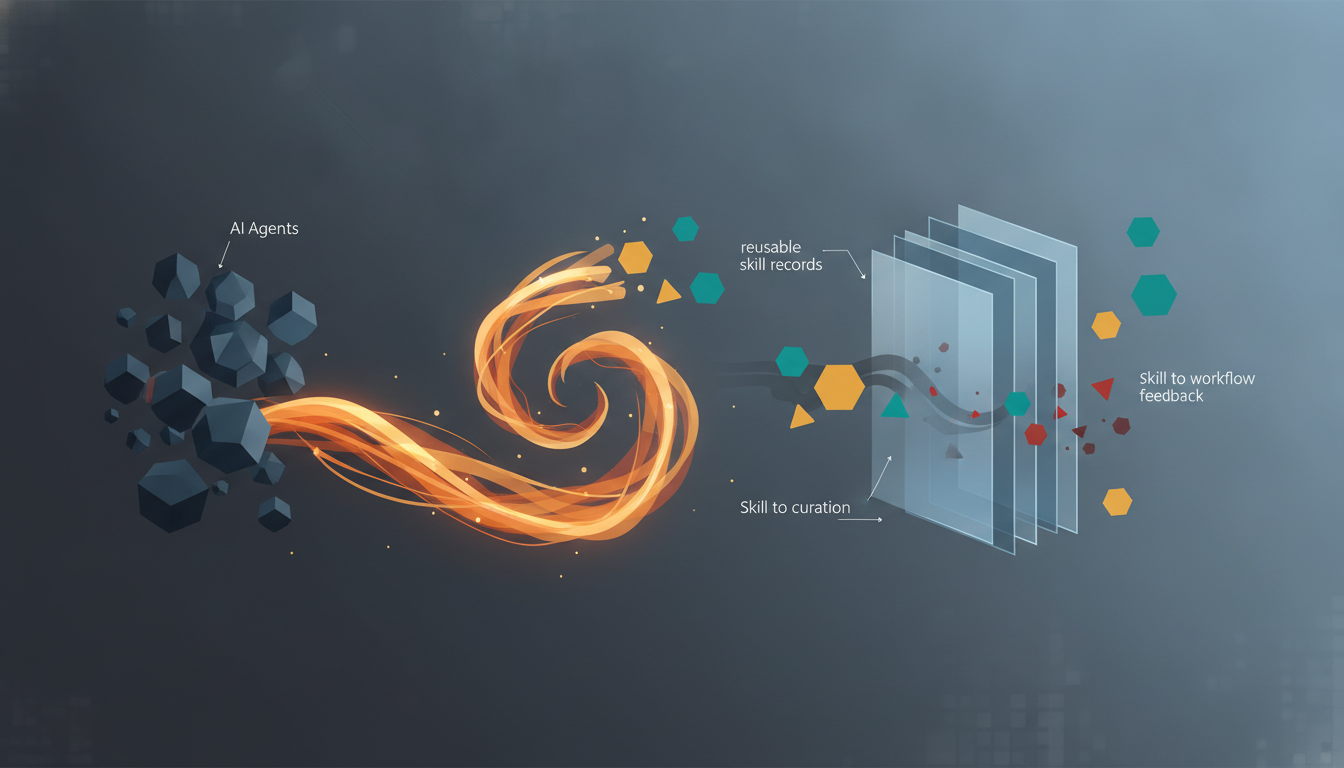
Researchers have introduced FlowEvo, a training-free framework that enables large language model agents to accumulate and refine problem-solving capabilities over time without updating model parameters, according to a paper published on arxiv.org.
According to the research, FlowEvo compiles successful execution traces into reusable skill records that persist in a “skill bank” at inference time. The framework operates through three coupled mechanisms: workflow-to-skill compilation that extracts executable artifacts from successful traces, skill-to-workflow feedback that retrieves accumulated skills for future problem solving, and skill curation that monitors downstream utility and suppresses skills causing negative transfer.
In experiments on benchmarks spanning interactive environments (ALFWorld) and code/math generation (HumanEval, GSM8K), FlowEvo achieved what the researchers describe as “the best accuracy-cost tradeoff among the evaluated baselines.” According to the paper, on ALFWorld specifically, FlowEvo achieved an 82.8% success rate—23.6 percentage points above the strongest baseline—while using less than half the average token usage per episode of the most efficient baseline.
The framework addresses a key limitation in current AI agents: while they can construct inference-time workflows combining reasoning, tool use, and code execution, the useful procedures discovered during execution are typically transient and “not retained in a form that can systematically benefit future tasks,” according to the researchers. The code has been made publicly available on GitHub.